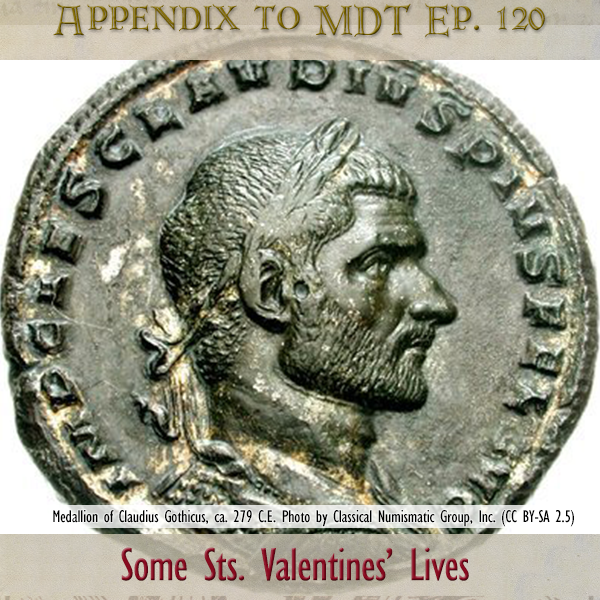
In this prelude appendix to our episode on saint’s lives, we hear versions of the life of St. Valentine from three different medieval sources.
Today’s Texts:
First English edition of the Nuremberg chronicle: being the Liber chronicarum of Dr. Hartmann Schedel. Edited and translated by Kosta Hadavas, U of Wisconsin-Madison Libraries, 2023, https://digital.library.wisc.edu/1711.dl/3SXNV3NHBQLFQ8J [used under a Creative Commons Attribution-NonCommercial 4.0 International License.]
Jacobus de Voragine. “Life of S. Valentine.” In The Golden Legend, or Lives of the Saints. Translated by William Caxton, edited by F.S. Ellis, vol. 3, J.M. Dent, 1900, pp. 42-45. Google Books.
Bede. Martyrologium de Natalitiis Sanctorum. In Patrologia Latina, edited by J.-P. Migne, vol. 94, col. 840A-842B, 1862. Google Books.
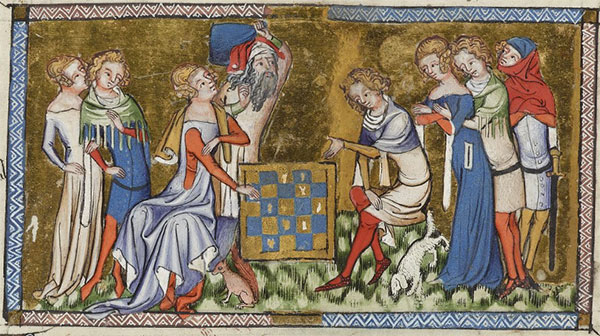
In this final episode in our holiday chess series, we finish off the last pages in William Caxton’s The Game and Playe of the Chesse, looking at the pawn and the importance of the common people to the realm, and we consider the how to explain pawns becoming queens in a medieval context.
Today’s Texts:
Caxton, William. The Game and Playe of the Chesse. Edited by Jenny Adams, TEAMS Middle English Text Series, U of Rochester, 2009.
Axon, William E.A. Introduction. Caxton’s Game and Play of the Chesse, Elliot Stock, 1883, pp. ix-lxxii. Google Books.
Murray, H.J.R. A History of Chess. Clarendon Press, 1913.
References:
Crist, Walter, et al. “Facilitating Interaction: Board Games as Social Lubricants in the Ancient Near East.” Oxford Journal of Archaeology, vol. 35, no. 2, May 2016, pp. 179–196. EBSCOhost, doi:10.1111/ojoa.12084.
Eales, Richard. “Changing Cultures: The Reception of Chess into Western Europe in the Middle Ages.” Ancient Board Games in Perspective: Papers from the 1990 British Museum Colloquium, With Additional Contributions, edited by I.L. Finkel, British Museum Press, 2007, pp. 162-168.
Finkel, Irving L. “Board Games in Perspective: An Introduction,” Ancient Board Games in Perspective: Papers from the 1990 British Museum Colloquium, With Additional Contributions, edited by I.L. Finkel, British Museum Press, 2007, pp. 1-4.
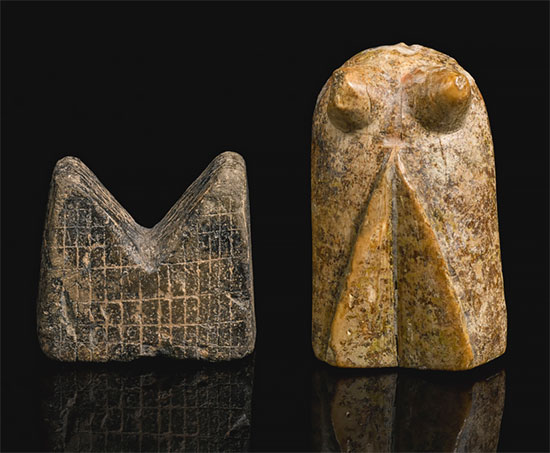
This fourth installment of our holiday chess series finishes off the back rank of pieces: the bishop (or alphyn), the knight, and the rook. We also explore a long-standing Wikipedia beef over rook terminology, and recommend a modern board game that plunges you into the paranoid world of zombie survival.
Today’s Text:
Caxton, William. The Game and Playe of the Chesse. Edited by Jenny Adams, TEAMS Middle English Text Series, U of Rochester, 2009.
References:
Eales, Richard. “Changing Cultures: The Reception of Chess into Western Europe in the Middle Ages.” Ancient Board Games in Perspective: Papers from the 1990 British Museum Colloquium, With Additional Contributions, edited by I.L. Finkel, British Museum Press, 2007, pp. 162-168.
Murray, H.J.R. A History of Chess. Clarendon Press, 1913.
Early bishops, knight, and rook: Sotheby’s Arts of the Islamic World Auction (20 April 2016), Lots 100 and 101. http://www.sothebys.com/en/auctions/2016/arts-islamic-world-l16220.html
Later bishop: http://ancientchess.com/page/play-courier-chess.htm & https://www.zafiyashop.xyz/vintage-chess-c-1_204_205_298/antique-vintage-wooden-st-george-black-bishop-chess-piece-spare-p-3500.html
Later bishop/rook comparison: https://www.jstor.org/stable/41694919?seq=1#page_scan_tab_contents
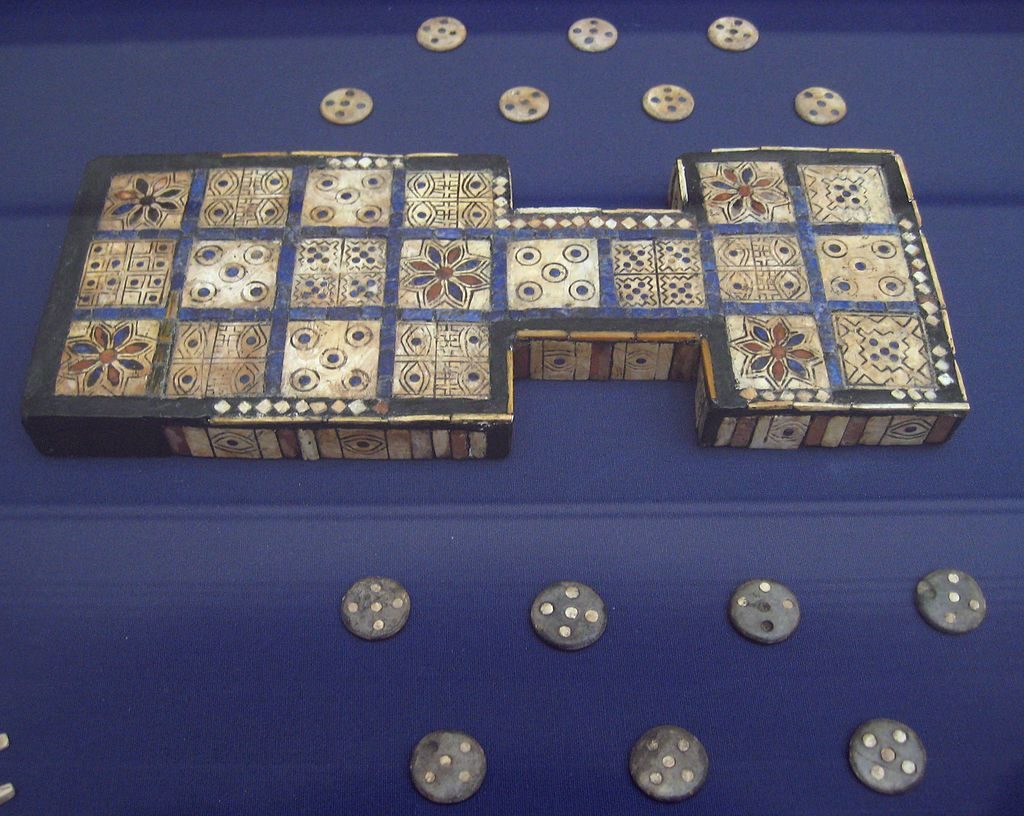
In the third episode of our holiday series of excerpts from William Caxton’s The Game and Playe of the Chesse, we learn about how the king and queen move, which was a bit different in the 15th century than it is today. We also consider the difficulty of working out the rules of an ancient game, even when you have the remarkable fortune to find them written down, as seen in the case of the Royal Game of Ur.
Today’s Text
Caxton, William. The Game and Playe of the Chesse. Edited by Jenny Adams, TEAMS Middle English Text Series, U of Rochester, 2009, http://d.lib.rochester.edu/teams/publication/adams-caxton-game-and-playe-of-the-chesse.
Finkel, Irving L. “On the Rules for the Royal Game of Ur.” Ancient Board Games in Perspective: Papers from the 1990 British Museum Colloquium, With Additional Contributions, edited by I.L. Finkel, British Museum Press, 2007, pp. 16-32.
References
Becker, Andrea. “The Royal Game of Ur.” Ancient Board Games in Perspective: Papers from the 1990 British Museum Colloquium, With Additional Contributions, edited by I.L. Finkel, British Museum Press, 2007, pp. 11-15.
Eales, Richard. “Changing Cultures: The Reception of Chess into Western Europe in the Middle Ages.” Ancient Board Games in Perspective: Papers from the 1990 British Museum Colloquium, With Additional Contributions, edited by I.L. Finkel, British Museum Press, 2007, pp. 162-168.
Murray, H.J.R. A History of Chess. Clarendon Press, 1913.
Murray, H.J.R. A History of Board-Games Other Than Chess. Clarendon Press, 1952.
Image: Board and pieces for the Royal Game of Ur, displayed at the British Museum (via Wikimedia Commons)
In this second installment of our holiday series of excerpts from William Caxton’s The Game and Playe of theChesse, we hear about the layout of the chessboard and what it represents. We also look at some of the games that chess replaced in Europe, including the Roman ludus latrunculorum, the Celtic fidchell or gwyddbwyell, and the Norse tafl or hnefatafl. And finally, we consider different ways in which the board of a board game might be constituted.
Murray, H.J.R. A History of Chess. Clarendon Press, 1913.
References
Eales, Richard. “Changing Cultures: The Reception of Chess into Western Europe in the Middle Ages.” Ancient Board Games in Perspective: Papers from the 1990 British Museum Colloquium, With Additional Contributions, edited by I.L. Finkel, British Museum Press, 2007, pp. 162-168.
Murray, H.J.R. A History of Board-Games Other Than Chess. Clarendon Press, 1952.
We kick off a holiday miniseries of chess lore from William Caxton’s The Game and the Playe of the Chesse with one version of how chess was invented. We then some historical corrections to this account and also hear one of the earliest written accounts of chess, the Persian Chatrang-namak.
Chatrang-namak. Translated in A History of Chess, H.J.R. Murray, Clarendon Press, 1913.
References:
Axon, William E.A. Introduction. Caxton’s Game and Play of the Chesse, Elliot Stock, 1883, pp. ix-lxxii. Google Books.
Crist, Walter, et al. “Facilitating Interaction: Board Games as Social Lubricants in the Ancient Near East.” Oxford Journal of Archaeology, vol. 35, no. 2, May 2016, pp. 179–196. EBSCOhost, doi:10.1111/ojoa.12084.
Eales, Richard. “Changing Cultures: The Reception of Chess into Western Europe in the Middle Ages.” Ancient Board Games in Perspective: Papers from the 1990 British Museum Colloquium, With Additional Contributions, edited by I.L. Finkel, British Museum Press, 2007, pp. 162-168.
Mark, Michael. “The Beginnings of Chess.” Ancient Board Games in Perspective: Papers from the 1990 British Museum Colloquium, With Additional Contributions, edited by I.L. Finkel, British Museum Press, 2007, pp. 138-157.
Murray, H.J.R. A History of Board-Games Other Than Chess. Clarendon Press, 1952.
Simpson, St John. “Homo Ludens: The Earliest Board Games in the Near East.” Ancient Board Games in Perspective: Papers from the 1990 British Museum Colloquium, With Additional Contributions, edited by I.L. Finkel, British Museum Press, 2007, pp. 5-10.





Recent Comments