- Download:
- MP3 Audio91 MB
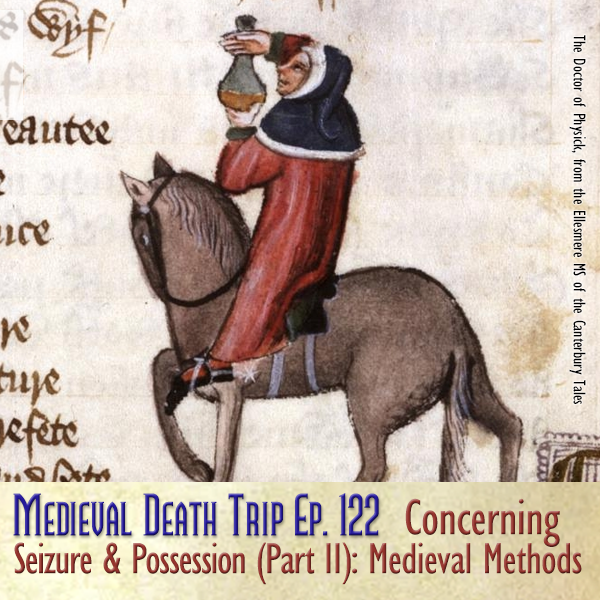
We complete our look at epilepsy in the Middle Ages by considering how religion and medicine intersect in surviving medical texts and how classical learning was reintroduced by looking at the example of John of Gaddesden, possibly the model for Chaucer’s Doctour of Phisik.
Today’s Texts:
- John of Gaddesden. “John of Gaddesden on Epilepsy.” Edited by William G. Lennox, translated by Adrian P. English, Annals of Medical History, vol. 1, no. 3, May 1939, pp. 283-307. Semantic Scholar.
- Origen. Commentary on the Gospel of Matthew, translated by John Patrick, in Ante-Nicene Fathers, vol. 9, edited by Allan Menzies, Christian Literature Publishing Co., 1896. New Advent, revised and edited by Kevin Knight, www.newadvent.org/fathers/1016.htm
- Herbarium. In Leechdoms, Wortcunning, and Starcraft of Early England, translated by Thomas Cockayne, vol. 1, Longman, Green, Longman, Roberts, and Green, 1864, pp. 1-325. Archive.org.
- Leech Book. Leechdoms, Wortcunning, and Starcraft of Early England, translated by Thomas Cockayne, vol. 2, Longman, Green, Longman, Roberts, and Green, 1864. Archive.org.
- “Life of St. Winefred.” Lives of the Cambro British Saints, of the Fifth and Immediate Succeeding Centuries, from Ancient Welsh & Latin MSS. in the British Museum and Elsewhere, with English Translations, an Explanatory Notes, edited and translated by W. J. Rees, Welsh MSS. Society, 1853, pp. 515-529. Google Books.
References:
- Capener, Norman. “John of Gaddesden: and the Crest of the Frederick Coller Surgical Society.” Annals of Surgery, vol. 154, suppl. 6, Dec. 1961, pp. 13-17. DOI: 10.1097/00000658-196112000-00003. PubMed Central.
- Dendle, Peter. “Lupines, Manganese, and Devil-Sickness: An Anglo-Saxon Medical Response to Epilepsy.” Bulletin of the History of Medicine, vol. 75, no. 1, Spring 2001, pp. 91-101. JSTOR, www.jstor.org/stable/44445557
- Temkin, Owsei. The Falling Sickness: A History of Epilepsy from the Greeks to the Beginnings of Modern Neurology. 2nd ed., revised, Johns Hopkins Press, 1971. Archive.org.
Image Credit: The Doctor of Physick, from the Ellesmere manuscript of the Canterbury Tales (Huntington Library EL 26 C 9, via Wikimedia Commons).





I ran across your podcast doing a deeper dive on epilepsy since I have it. I developed it as an adult for an unknown reason (called “idiopathic”).
I’m fascinated by the rich history of its description and treatment which you’ve dug up.
The more modern treatment (until drugs were discovered) was segregation into “epilepsy” or “feeble-mindedness” colonies, prohibiting marriage and parenthood and adoption (solved with eugenics)
The stigma surrounding it (including the religious stigma) still exists in the USA today. Lots of people don’t understand it (or don’t want to).
Thanks for your comment! I only got a glance at the history of theories and treatments in the 18th and 19th centuries, but it really does seem like a case of “two steps forward, one step back” with each new development up until you get some real understanding with EEGs in the early 20th century (not to mention genuinely effective pharmaceutical treatments).
The intersection of religion and medicine in John of Gaddesden’s work really stood out—it’s striking how even a learned physician like him had to weave spiritual explanations into his treatments. My own epilepsy is idiopathic as well, and it makes me wonder how much of that medieval blending of faith and observation still lingers in modern misunderstandings of the condition.