In this episode, we bring Kormak’s Saga to its conclusion and find out if one man’s unrelenting infatuation can triumph over a curse. We also talk about recognizing witches’ eyes and read between the lines on our protagonists’ relationship.
Today’s Text:
The Life and Death of Cormac the Skald. Translated by W.G. Collingwood and J. Stefansson. Viking Club Translation Series, no. 1., Wm Holmes, Ltd., 1902. Google Books.
Ármann Jakobsson. “The Trollish Acts of Þorgrímr the Witch: The Meanings of Troll and Ergi in Medieval Iceland.” Saga-Book, vol. 32, 2008, pp. 39-68. JSTOR.
Byock, Jesse. Viking Age Iceland. Penguin, 2001.
Finlay, Alison. “Níð, Adultery, and Feud in Bjarnar saga Hítdœlakappa.” Saga-Book, vol. 23, 1990-1993, pp. 158-178. JSTOR.
—. “Skalds, Troubadours and Sagas.” Saga-Book, vol. 24, 1994-1997, pp. 105-154. JSTOR.
Hollander, Lee. “The Case of the Skald Kormak.” Monatshefte für Deutschen Unterricht, vol. 35, no. 3/4, Mar.-Apr. 1943, pp. 107-115. JSTOR.
Jochens, Jenny. “The Illicit Love Visit: An Archaeology of Old Norse Sexuality.” Journal of the History of Sexuality, vol. 1, no. 3, Jan. 1991, pp. 357-392. JSTOR.
McDaniel, Walton Brooks. “The Pupula Duplex and Other Tokens of an ‘Evil Eye’ in the Light of Ophthalmology.” Classical Philology, vol. 13, no. 4, Oct. 1918, pp. 335-346. JSTOR.
Meylan, Nicholas. “The Magical Power of Poetry.” Saga-Book, vol. 37, 2013, pp. 43-60. JSTOR.
Raffield, Ben, Neil Price, and Mark Collard. “Polygyny, Concubinage, and the Social Lives of Women in Viking-Age Scandinavia.” Viking and Medieval Scandinavia, vol. 13, 2017, pp. 165-210. JSTOR.
Roesdahl, Else. The Vikings. Revised ed., translated by Susan M. Margeson and Kirsten Williams, Penguin, 1998.
Audio Credits:
Return of the Jedi. Directed by Richard Marquand. 20th Century-Fox, 1983.
Dylan, Bob. “I Shall Be Free No. 10.” Another Side of Bob Dylan, Columbia Records, 1964. YouTube.
The Princess Bride. Directed by Rob Reiner. 20th Century-Fox, 1987.
“Kormak’s Theme” and “Harpish Improvisations” composed and performed by Patrick Lane.
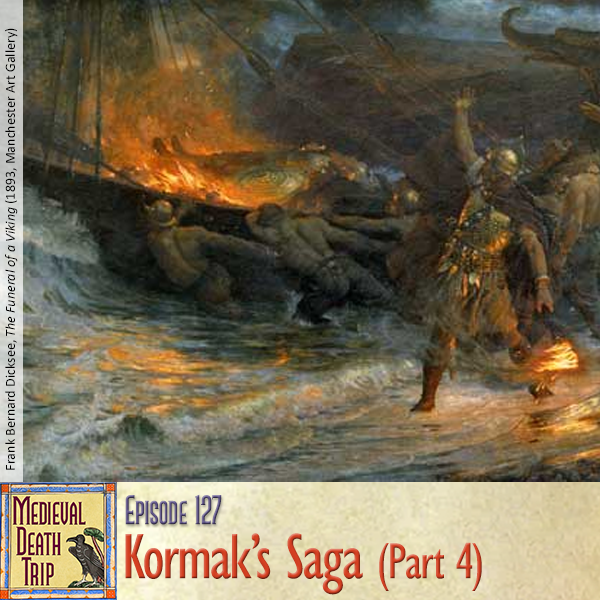
Image Credit: Detail from the painting The Funeral of a Viking by Frank Bernard Dicksee, 1893 (Manchester Art Gallery).
In Part 3 of Kormak’s Saga, we complete the story of Holmgang Bersi and introduce a new rival for Steingerd’s affections. There’s also a magical sea beast, more slanderous poetry, and we discuss Norse names.
Today’s Text:
The Life and Death of Cormac the Skald. Translated by W.G. Collingwood and J. Stefansson. Viking Club Translation Series, no. 1., Wm Holmes, Ltd., 1902. Google Books.
Finlay, Alison. “Níð, Adultery, and Feud in Bjarnar saga Hítdœlakappa.” Saga-Book, vol. 23, 1990-1993, pp. 158-178. JSTOR.
Jochens, Jenny. “The Illicit Love Visit: An Archaeology of Old Norse Sexuality.” Journal of the History of Sexuality, vol. 1, no. 3, Jan. 1991, pp. 357-392. JSTOR.
The Laxdale Saga. Translated by Muriel A. C. Press, 1880. The Icelandic Saga Database, edited by Sveinbjörn Þórðarson, https://sagadb.org/laxdaela_saga.en.
Meylan, Nicholas. “The Magical Power of Poetry.” Saga-Book, vol. 37, 2013, pp. 43-60. JSTOR.
Raffield, Ben, Neil Price, and Mark Collard. “Polygyny, Concubinage, and the Social Lives of Women in Viking-Age Scandinavia.” Viking and Medieval Scandinavia, vol. 13, 2017, pp. 165-210. JSTOR.
Roesdahl, Else. The Vikings. Revised ed., translated by Susan M. Margeson and Kirsten Williams, Penguin, 1998.
Audio Credits:
“Cincinnati Kid.” The Kids in the Hall, Season 2, Ep. 16, 2 April 1991. YouTube.
The Lord of the Rings: The Two Towers. Directed by Peter Jackson, New Line Cinema, 2002.
The Big Lebowski. Written by Joel Coen and Ethan Coen, Gramercy Pictures, 1998.
“Kormak’s Theme” and “Harpish Improvisations” composed and performed by Patrick Lane.
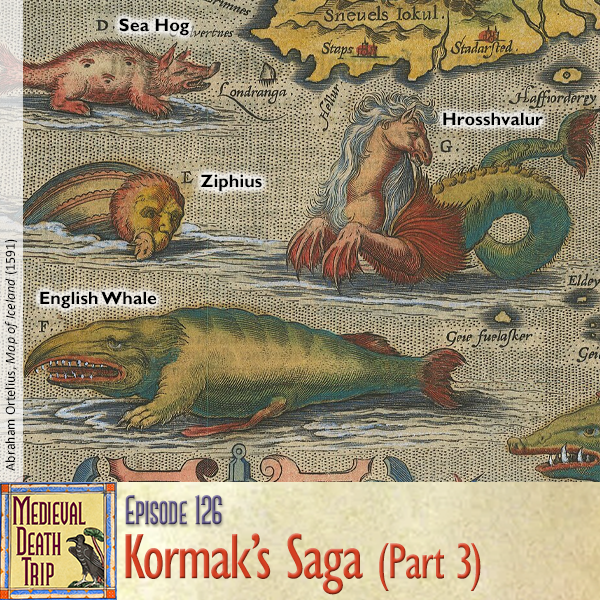
Image Credits: Detail from Abraham Ortelius, Map of Iceland (1591). Via Wikimedia Commons.
We continue with Kormak’s Saga as a new lead character is introduced, Holmgang Bersi, who soon becomes ensnared in the drama of the cursed romance of Kormak and Steingerd. We also learn the basic of Viking duelling and its weapons, and also try to get a grip on the slippery terminology of Norse magic.
Today’s Text:
The Life and Death of Cormac the Skald. Translated by W.G. Collingwood and J. Stefansson. Viking Club Translation Series, no. 1., Wm Holmes, Ltd., 1902. Google Books.
Biel, William. “Memory of Iron: Object Rhetoric and Collective Memory in Laxdæla saga.” Scandinavian-Canadian Studies / Études Scandinaves au Canada, vol. 28, 2021, pp. 178-203, https://scancan.net/index.php/scancan/article/view/206/411.
The Saga of King Hrolf Kraki. Translated by Jesse Byock, Penguin, 1998.
Jones, Gwyn. “Some Characteristics of the Icelandic ‘Hólmganga.'” Journal of English and Germanic Philology, vol. 32, no. 2, Apr. 1933, pp. 203-224. JSTOR.
We inaugurate our first “Saga Summer” a bit late this year, but starting with an early poet’s saga, a tale of love and betrayal, duels and magic. This is Part 1 (of 4) of Kormak’s Saga.
Today’s Texts:
The Life and Death of Cormac the Skald. Translated by W.G. Collingwood and J. Stefansson. Viking Club Translation Series, no. 1., Wm Holmes, Ltd., 1902. Google Books.
Egil’s Saga. Translated by Hermann Pálsson and Paul Edwards, Penguin, 1976.
Egil’s Saga. Translated by Bernard Skudder, The Sagas of Icelanders: A Selection, Penguin, 2001, pp. 3-184.
References:
Andersson, T.M. “The Emergence of Vernacular Literature in Iceland.” Mosaic: An Interdisciplinary Critical Journal, vol. 8, no. 4, Summer 1975, pp. 161-169. JSTOR.
Finlay, Alison. “Skalds, Troubadours and Sagas.” Saga-Book, vol. 24, 1994-1997, pp. 105-154. JSTOR.
Hollander, Lee. “The Case of the Skald Kormak.” Monatshefte für Deutschen Unterricht, vol. 35, no. 3/4, Mar.-Apr. 1943, pp. 107-115. JSTOR.
Jónas Kristjánsson. Eddas and Sagas. Translated by Peter Foote, Hið íslenska bókmenntafélag, 1997.
Malm, Mats. “Skalds, Runes, and Voice.” Viking and Medieval Scandinavia, vol. 6, 2010, pp. 135-46. JSTOR.
O’Donoghue, Heather. Old Norse-Icelandic Literature: A Short Introduction. Blackwell, 2005.





Recent Comments