In Part 3 of Kormak’s Saga, we complete the story of Holmgang Bersi and introduce a new rival for Steingerd’s affections. There’s also a magical sea beast, more slanderous poetry, and we discuss Norse names.
Today’s Text:
The Life and Death of Cormac the Skald. Translated by W.G. Collingwood and J. Stefansson. Viking Club Translation Series, no. 1., Wm Holmes, Ltd., 1902. Google Books.
Finlay, Alison. “Níð, Adultery, and Feud in Bjarnar saga Hítdœlakappa.” Saga-Book, vol. 23, 1990-1993, pp. 158-178. JSTOR.
Jochens, Jenny. “The Illicit Love Visit: An Archaeology of Old Norse Sexuality.” Journal of the History of Sexuality, vol. 1, no. 3, Jan. 1991, pp. 357-392. JSTOR.
The Laxdale Saga. Translated by Muriel A. C. Press, 1880. The Icelandic Saga Database, edited by Sveinbjörn Þórðarson, https://sagadb.org/laxdaela_saga.en.
Meylan, Nicholas. “The Magical Power of Poetry.” Saga-Book, vol. 37, 2013, pp. 43-60. JSTOR.
Raffield, Ben, Neil Price, and Mark Collard. “Polygyny, Concubinage, and the Social Lives of Women in Viking-Age Scandinavia.” Viking and Medieval Scandinavia, vol. 13, 2017, pp. 165-210. JSTOR.
Roesdahl, Else. The Vikings. Revised ed., translated by Susan M. Margeson and Kirsten Williams, Penguin, 1998.
Audio Credits:
“Cincinnati Kid.” The Kids in the Hall, Season 2, Ep. 16, 2 April 1991. YouTube.
The Lord of the Rings: The Two Towers. Directed by Peter Jackson, New Line Cinema, 2002.
The Big Lebowski. Written by Joel Coen and Ethan Coen, Gramercy Pictures, 1998.
“Kormak’s Theme” and “Harpish Improvisations” composed and performed by Patrick Lane.
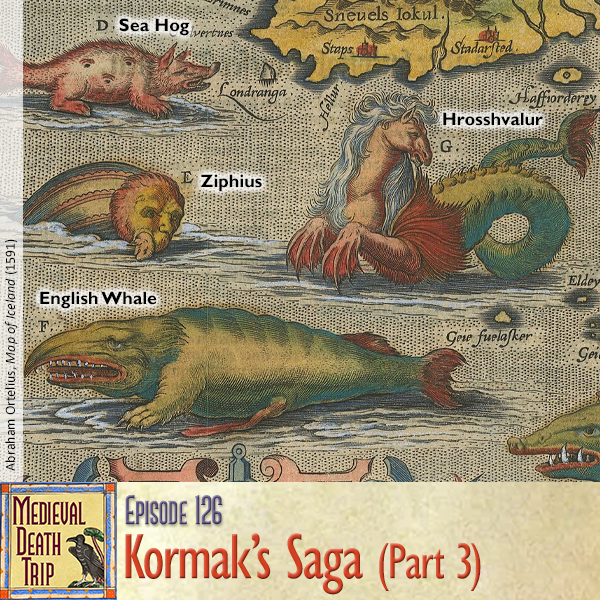
Image Credits: Detail from Abraham Ortelius, Map of Iceland (1591). Via Wikimedia Commons.
We continue with Kormak’s Saga as a new lead character is introduced, Holmgang Bersi, who soon becomes ensnared in the drama of the cursed romance of Kormak and Steingerd. We also learn the basic of Viking duelling and its weapons, and also try to get a grip on the slippery terminology of Norse magic.
Today’s Text:
The Life and Death of Cormac the Skald. Translated by W.G. Collingwood and J. Stefansson. Viking Club Translation Series, no. 1., Wm Holmes, Ltd., 1902. Google Books.
Biel, William. “Memory of Iron: Object Rhetoric and Collective Memory in Laxdæla saga.” Scandinavian-Canadian Studies / Études Scandinaves au Canada, vol. 28, 2021, pp. 178-203, https://scancan.net/index.php/scancan/article/view/206/411.
The Saga of King Hrolf Kraki. Translated by Jesse Byock, Penguin, 1998.
Jones, Gwyn. “Some Characteristics of the Icelandic ‘Hólmganga.'” Journal of English and Germanic Philology, vol. 32, no. 2, Apr. 1933, pp. 203-224. JSTOR.
We inaugurate our first “Saga Summer” a bit late this year, but starting with an early poet’s saga, a tale of love and betrayal, duels and magic. This is Part 1 (of 4) of Kormak’s Saga.
Today’s Texts:
The Life and Death of Cormac the Skald. Translated by W.G. Collingwood and J. Stefansson. Viking Club Translation Series, no. 1., Wm Holmes, Ltd., 1902. Google Books.
Egil’s Saga. Translated by Hermann Pálsson and Paul Edwards, Penguin, 1976.
Egil’s Saga. Translated by Bernard Skudder, The Sagas of Icelanders: A Selection, Penguin, 2001, pp. 3-184.
References:
Andersson, T.M. “The Emergence of Vernacular Literature in Iceland.” Mosaic: An Interdisciplinary Critical Journal, vol. 8, no. 4, Summer 1975, pp. 161-169. JSTOR.
Finlay, Alison. “Skalds, Troubadours and Sagas.” Saga-Book, vol. 24, 1994-1997, pp. 105-154. JSTOR.
Hollander, Lee. “The Case of the Skald Kormak.” Monatshefte für Deutschen Unterricht, vol. 35, no. 3/4, Mar.-Apr. 1943, pp. 107-115. JSTOR.
Jónas Kristjánsson. Eddas and Sagas. Translated by Peter Foote, Hið íslenska bókmenntafélag, 1997.
Malm, Mats. “Skalds, Runes, and Voice.” Viking and Medieval Scandinavia, vol. 6, 2010, pp. 135-46. JSTOR.
O’Donoghue, Heather. Old Norse-Icelandic Literature: A Short Introduction. Blackwell, 2005.
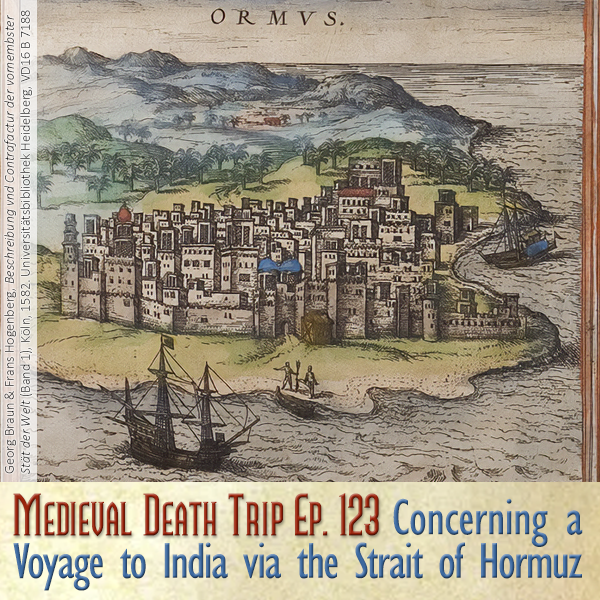
As vacation season kicks off, we revisit 14th-century traveler Friar Odoric at the very start of his journey, as he crosses from the Black Sea to the Persian Gulf, passes through the Strait of Hormuz, and makes shore in India.
Today’s Texts:
Odoric of Friuli. “The Eastern Parts of the World Described, By Friar Odoric the Bohemian, of Friuli, in the Province of Saint Anthony.” In Cathay and the Way Thither, edited by Henry Yule, vol. 1, Hakluyt Society, 1866. Google Books.
“Viaggio del Beato Frate Odorico di Porto Maggiore Del Friuli.” Edited by Ramusio, Delle Navigationi et Viaggi, vol. 2, Venice, Giunti, 1583. pp. 253-257. Google Books.
Odoric of Friuli. “Latin Text of Odoric; from a MS in the Bibliotèque Impériale.” In Cathay and the Way Thither, edited by Henry Yule, vol. 2, Hakluyt Society, 1866, pp. i-xlii. Google Books.
References:
Small, Margaret. “Transformer and Influencer: Giovanni Battista Ramusio’s Impact on Wester European Geography.“ Journal of Early Modern Studies, vol. 12, 2023, pp. 39-54. DOI: http://dx.doi.org/10.36253/JEMS-2279-7149-14383.
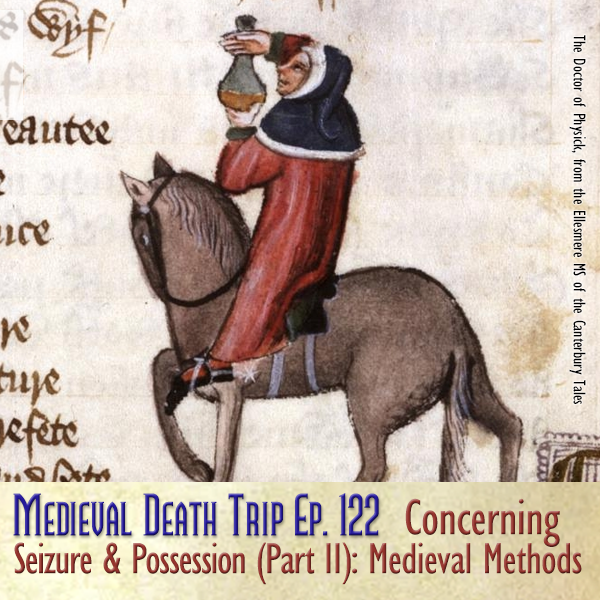
We complete our look at epilepsy in the Middle Ages by considering how religion and medicine intersect in surviving medical texts and how classical learning was reintroduced by looking at the example of John of Gaddesden, possibly the model for Chaucer’s Doctour of Phisik.
Today’s Texts:
John of Gaddesden. “John of Gaddesden on Epilepsy.” Edited by William G. Lennox, translated by Adrian P. English, Annals of Medical History, vol. 1, no. 3, May 1939, pp. 283-307. Semantic Scholar.
Origen. Commentary on the Gospel of Matthew, translated by John Patrick, in Ante-Nicene Fathers, vol. 9, edited by Allan Menzies, Christian Literature Publishing Co., 1896. New Advent, revised and edited by Kevin Knight, www.newadvent.org/fathers/1016.htm
Herbarium. In Leechdoms, Wortcunning, and Starcraft of Early England, translated by Thomas Cockayne, vol. 1, Longman, Green, Longman, Roberts, and Green, 1864, pp. 1-325. Archive.org.
Leech Book. Leechdoms, Wortcunning, and Starcraft of Early England, translated by Thomas Cockayne, vol. 2, Longman, Green, Longman, Roberts, and Green, 1864. Archive.org.
“Life of St. Winefred.” Lives of the Cambro British Saints, of the Fifth and Immediate Succeeding Centuries, from Ancient Welsh & Latin MSS. in the British Museum and Elsewhere, with English Translations, an Explanatory Notes, edited and translated by W. J. Rees, Welsh MSS. Society, 1853, pp. 515-529. Google Books.
References:
Capener, Norman. “John of Gaddesden: and the Crest of the Frederick Coller Surgical Society.” Annals of Surgery, vol. 154, suppl. 6, Dec. 1961, pp. 13-17. DOI: 10.1097/00000658-196112000-00003. PubMed Central.
Dendle, Peter. “Lupines, Manganese, and Devil-Sickness: An Anglo-Saxon Medical Response to Epilepsy.” Bulletin of the History of Medicine, vol. 75, no. 1, Spring 2001, pp. 91-101. JSTOR, www.jstor.org/stable/44445557
Temkin, Owsei. The Falling Sickness: A History of Epilepsy from the Greeks to the Beginnings of Modern Neurology. 2nd ed., revised, Johns Hopkins Press, 1971. Archive.org.
Image Credit: The Doctor of Physick, from the Ellesmere manuscript of the Canterbury Tales (Huntington Library EL 26 C 9, via Wikimedia Commons).
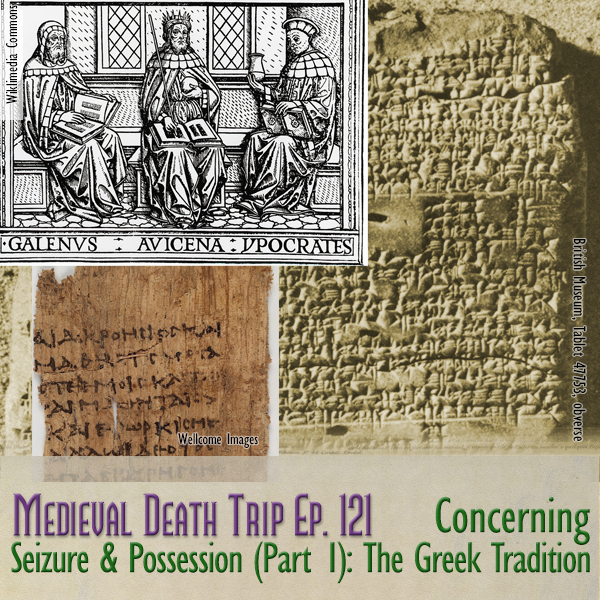
This episode we begin a two-part exploration into the understanding and treatment of epilepsy in the middle ages. But to get to the medieval, we have to start with its ancient antecedents, so here in Part 1, we look at texts produced by the Hippocratic school and its later followers.
Today’s Texts:
Lucretius. On the Nature of Things. Translated by John Selby Watson and John Mason Good, George Bell & Sons, 1893. Internet Archive.
Wilson, J.V. Kinnier, and E. H. Reynolds, translators. “Translation and Analysis of a Cuneiform Text Forming Part of a Babylonian Treatise on Epilepsy,” Medical History, vol. 34, 1990, pp. 185-198. National Center for Biotechnical Information,www.ncbi.nlm.nih.gov/pmc/articles/PMC1036070/
Hippocrates. “On the Sacred Disease.” The Genuine Works of Hippocrates, vol. 2, translated by Francis Adams, Sydenham Society, 1849, pp. 831-858. Google Books.
Galen. “Advice for an Epileptic Boy.” Translated by Owsei Temkin, Texts and Documents, reprinted from Bulletin of the Institute of the History of Medicine, vol. 2, no. 3, May 1934, pp. 179-189. Archive.org.
Paulus Ægineta. The Medical Works of Paulus Ægineta, the Greek Physician. Vol. 1, edited and translated by Francis Adams, J. Welsh, 1834. Google Books.
References:
AL-Zwaini, Isam Jaber, and Ban Adbul-Hameed Majeed Albadri. “Epilepsy — The Long Journey of the Sacred Disease.” Epilepsy — Advances in Diagnosis and Therapy, IntechOpen, 2019, pp. 1-10. Academia.edu.
Diamantis, Aristidis, Kalliopi Sidiropoulou, and Emmanouil Magiorkinis. “Epilepsy during the Middle Ages, the Renaissance and the Enlightenment.” Journal of Neurology, vol. 257, 2010, pp. 691-698. DOI: 10.1007/s00415-009-5433-7. Academia.edu.
Katz, Arnold M. “Knowledge of Circulation Before William Harvey.” Circulation, vol. 15, May 1957, pp. 726-734. American Heart Association.
Patel, Puja, and Solomon L. Moshé. “The evolution of the concepts of seizures and epilepsy: What’s in a name?” Epilepsia Open, vol. 5, 2020, pp. 22-35. DOI: 10.1002/EPI4.12375. Academia.edu.
Temkin, Owsei. The Falling Sickness: A History of Epilepsy from the Greeks to the Beginnings of Modern Neurology. 2nd ed., revised, Johns Hopkins Press, 1971. Archive.org.
Image Credits:
Babylonian tablet on epilepsy (British Museum, Tablet 47753, obverse, CC BY-NC-SA 4.0).





Recent Comments