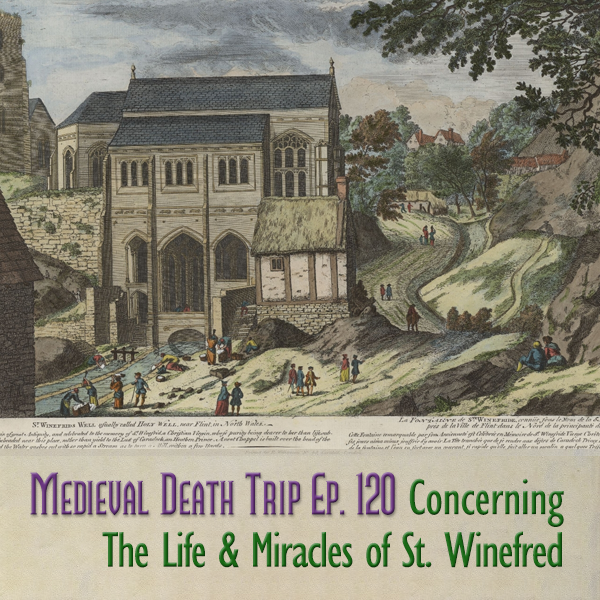
As a follow-up to our 2025 saint’s-life generating Advent Calendar game, we hear an actual medieval saint’s life and discuss how we get some of our saintly terminology. You’ll also find out where you can get a downloadable version of the Advent Calendar game!
Today’s Texts:
“Life of St. Winefred.” Lives of the Cambro British Saints, of the Fifth and Immediate Succeeding Centuries, from Ancient Welsh & Latin MSS. in the British Museum and Elsewhere, with English Translations, an Explanatory Notes, edited and translated by W. J. Rees, Welsh MSS. Society, 1853, pp. 515-529. Google Books.
“The Miracles of St. Winifred’s Well.” The British Medical Journal, vol. 2, no. 1762, 13 Oct. 1894, p. 829. JSTOR, www.jstor.org/stable/20230146
The Rule of St. Benedict. Translated by D. Oswald Hunter Blair, 2nd ed., Sands & Co,m 1907. Google Books.
References:
Dendle, Peter. “Lupines, Manganese, and Devil-Sickness: An Anglo-Saxon Medical Response to Epilepsy.” Bulletin of the History of Medicine, vol. 75, no. 1, Spring 2001, pp. 91-101. JSTOR, www.jstor.org/stable/44445557
Head, Thomas. “Hagiography.” Reprinted from ORB: the On-line Reference Book for Medieval Studies, 1999. Hagiography Society, 2013, www.hagiographysociety.org/?page_id=678
Keune, Jon. “Comparative vs. Hagiology: Two Variant Approaches to the Field.” Religious Studies, vol. 10, no. 10, 14 Oct. 2019, p. 575. MDPI, doi.org/10.3390/rel10100575
Stumpe, Lynne Heidi. “Display and Veneration of Holy Relics at St Winefriede’s Well and Stonyhurst.” Journal of Museum Ethnography, no. 22, Dec. 2009, pp. 63-81. JSTOR, www.jstor.org/stable/41417138
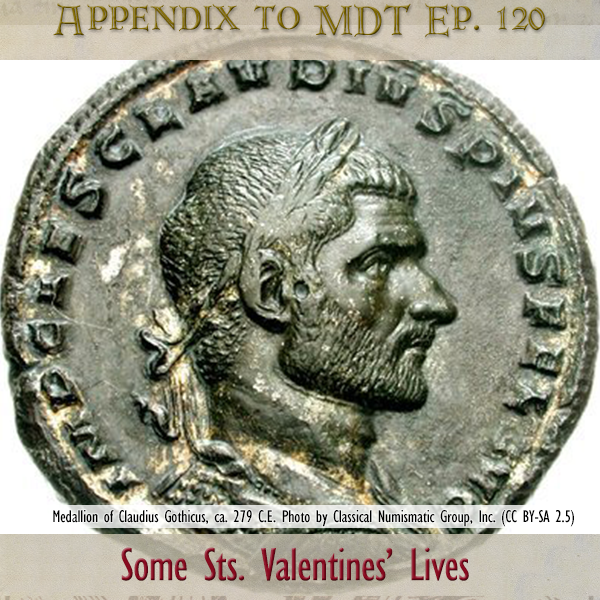
In this prelude appendix to our episode on saint’s lives, we hear versions of the life of St. Valentine from three different medieval sources.
Today’s Texts:
First English edition of the Nuremberg chronicle: being the Liber chronicarum of Dr. Hartmann Schedel. Edited and translated by Kosta Hadavas, U of Wisconsin-Madison Libraries, 2023, https://digital.library.wisc.edu/1711.dl/3SXNV3NHBQLFQ8J [used under a Creative Commons Attribution-NonCommercial 4.0 International License.]
Jacobus de Voragine. “Life of S. Valentine.” In The Golden Legend, or Lives of the Saints. Translated by William Caxton, edited by F.S. Ellis, vol. 3, J.M. Dent, 1900, pp. 42-45. Google Books.
Bede. Martyrologium de Natalitiis Sanctorum. In Patrologia Latina, edited by J.-P. Migne, vol. 94, col. 840A-842B, 1862. Google Books.
As we enter the season of elves and Christmas spirits, we follow up on our fairy theme from last episode with a look at the famous 16th-century German hausgeist, Hinzelmann the Kobold — but don’t call him that to his face!
Today’s Texts:
Keightley, Thomas. The Fairy Mythology. E.G. Bohn, 1850. Google Books.
Der vielförmige Hintzelmann oder umbständliche und merckwürdige Erzehlung von einem Geist, so sich auf dem Hause Hudemühlen, und hernach zu Estrup im Lande Lüneburg unter vielfältigen Gestalten. Leipzig, 1704. Niedersächsische Staats- und Universitätsbibliothek Göttingen.
Grimm, Jacob, and Wilhelm Grimm. Deutsche Sagen. Berlin, 1816. Google Books.
References:
Bullen, Barrie. “Before the Ouija board: William Rossetti’s Diary Gives an Insight into Victorian Séances.” The Conversation, 23 Dec. 2021.
Dorson, Richard M. “The First Group of British Folklorists.” Journal of American Folklore, vol. 68, no. 267, 1955, pp. 1-8. JSTOR, www.jstor.org/stable/537105
Music credit: Ludwig van Beethoven, Piano Sonata No. 28 in A Major, Op. 101, composed in 1816 (same year as the publication of the Grimms’ Deutsche Sagen), performed by Paul Pitman (CC-PD). Musopen.
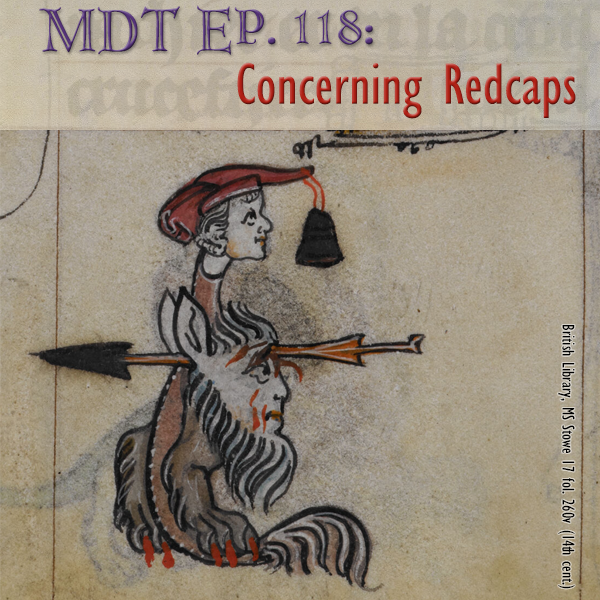
For our eleventh anniversary episode, we follow the fairy path of the redcap, from recent cinema through tabletop gaming, into Victorian folklorists and Romantic balladeers, and finally hunting up their ancestry in medieval manuscripts.
Henderson, William. Notes on the Folk-Lore of the Northern Counties of England and the Borders. W. Satchell, Peyton, & Co., 1879. Internet Archive.
Leyden, John. “Lord Soulis.” Minstrelsy of the Scottish Border, vol. 2, edited by Walter Scott, James Ballantyne, 1803, pp. 353-388. Google Books.
Leland, Charles Godfrey. “Etrusco-Roman Remains in Modern Tuscan Tradition.” Congrès International des Traditions Populaires, Première Session, Paris 1889, Société d’Èditions Scientifiques, 1891. Google Books.
Gervase of Tilbury. Otia imperialia: Recreation for an Emperor. Edited and translated by S.E. Banks and J.W. Binns. Clarendon Press, 2002.
Thomas of Walsingham. Historia Anglicana. Edited by Henry Thomas Riley, vol. 1, Longman, Green, Longman, Roberts, and Green, 1863. Google Books.
Croker, Thomas Crofton. Fairy Legends and Traditions of the South of Ireland. 2nd ed., John Murray, 1838. Google Books.
Hutton, Ronald. “The Making of the Early Modern British Fairy Tradition.” The Historical Journal, vol. 57, no. 4, 2014, pp. 1135-1156. JSTOR, www.jstor.org/stable/24531978
Sinclair, John. The Statistical Account of Scotland. Vol. 16, William Creech, 1791. Google Books.
Teverson, Andrew. 2025. “William Henderson: ‘A Folk-Lore Student before Folk-Lore Came into Vogue.'” Folklore, vol. 136, no. 3, pp. 447–65. Taylor and Francis.
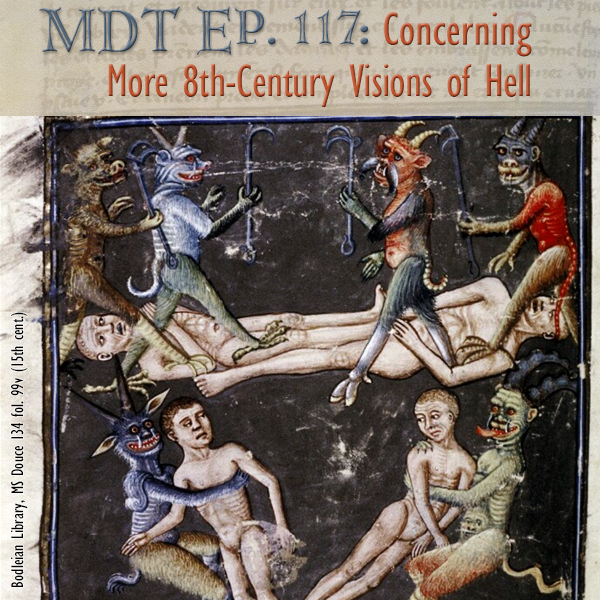
This episode we continue further with Bede as he relates two more afterlife visions of a more infernal nature, and then we hear Gregory the Great answer some questions about the nature of Hell.
Today’s Texts:
Bede. Ecclesiastical History. In The Complete Works of Venerable Bede. Edited and translated by J.A. Giles, vols. II & III, Whittaker and Co., 1843. Google Books.
Rabin, Andrew. “Bede, Dryhthelm, and the Witness to the Other World: Testimony and Conversion in the Historia ecclesiastica.” Modern Philology, vol. 106, no. 3, Feb. 2009, pp. 375-398. JSTOR, www.jstor.org/stable/10.1086/605070
Snyder, Susan. “The Left Hand of God: Despair in Medieval and Renaissance Tradition.” Studies in the Renaissance, vol. 12, 1965, pp. 18-59. JSTOR, www.jstor.org/stable/2857068
Image: Detail of the torments of the damned from Livre de la Vigne nostre Seigneur, Bodleian Library, MS Douce 134, fol. 99v.
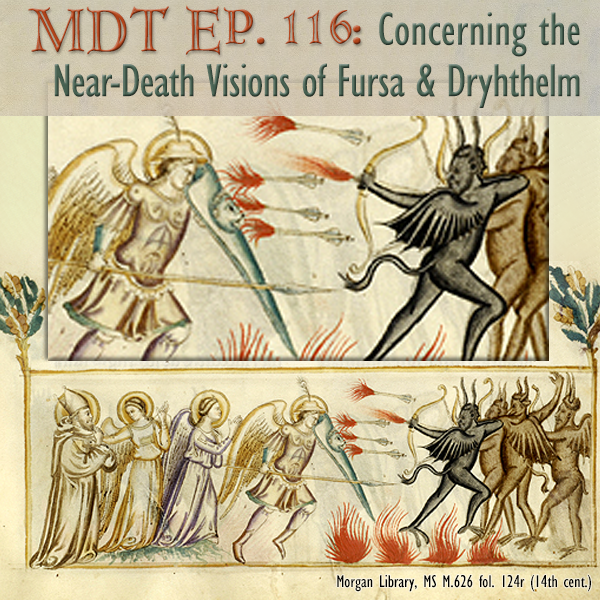
This episode we explore two glimpses of the afterlife presented by the Venerable Bede and consider how they relate to the modern conception of the near death experience.
Today’s Text
Bede. Ecclesiastical History. In The Complete Works of Venerable Bede. Edited and translated by J.A. Giles, vols. II & III, Whittaker and Co., 1843. Google Books.
Cronin, Anthony. “The Historical Saint Fursey: The Achievements and Legacy of Haggardstown’s Patron Saint.” Journal of the County Louth Archaeological and History Society, vol. 27, no. 4, 2012, pp. 536-552. JSTOR, www.jstor.org/stable/23644252
Hamann, Stefanie. “St Fursa, the Genealogy of an Irish Saint — the Historical Person and His Cult.” Proceedings of the Royal Irish Academy: Archaeology, Culture, History, Literature, vol. 112c, 2012, pp. 147-187. JSTOR, www.jstor.org/stable/41714684
Rabin, Andrew. “Bede, Dryhthelm, and the Witness to the Other World: Testimony and Conversion in the Historia ecclesiastica.” Modern Philology, vol. 106, no. 3, Feb. 2009, pp. 375-398. JSTOR, www.jstor.org/stable/10.1086/605070.
White, Claire, Michael Kinsella, and Jesse Bering. “How to Know You’ve Survived Death: A Cognitive Account of the Popularity of Contemporary Post-mortem Survival Narratives.” Method and the Study of Religion, vol. 30, no. 3, 2018, pp. 279-299. JSTOR,www.jstor.org/stable/26507489






Recent Comments