- Download:
- MP3 Audio103 MB
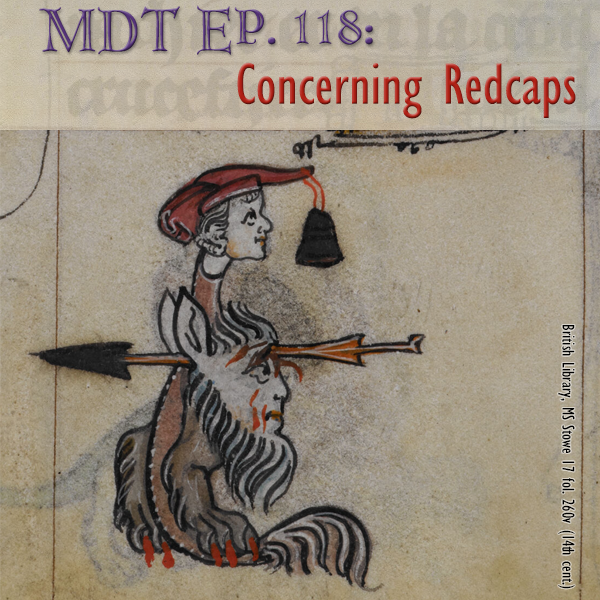
For our eleventh anniversary episode, we follow the fairy path of the redcap, from recent cinema through tabletop gaming, into Victorian folklorists and Romantic balladeers, and finally hunting up their ancestry in medieval manuscripts.
Today’s Texts:
- “Redcap.” Monster Manual III, edited by Greg Collins, John D. Rateliff, and Gary Sarli. Wizards of the Coast, 2004. Internet Archive, https://archive.org/details/monster-manual-iii/page/n137/mode/2up
- Henderson, William. Notes on the Folk-Lore of the Northern Counties of England and the Borders. W. Satchell, Peyton, & Co., 1879. Internet Archive.
- Leyden, John. “Lord Soulis.” Minstrelsy of the Scottish Border, vol. 2, edited by Walter Scott, James Ballantyne, 1803, pp. 353-388. Google Books.
- Leland, Charles Godfrey. “Etrusco-Roman Remains in Modern Tuscan Tradition.” Congrès International des Traditions Populaires, Première Session, Paris 1889, Société d’Èditions Scientifiques, 1891. Google Books.
- Gervase of Tilbury. Otia imperialia: Recreation for an Emperor. Edited and translated by S.E. Banks and J.W. Binns. Clarendon Press, 2002.
- Thomas of Walsingham. Historia Anglicana. Edited by Henry Thomas Riley, vol. 1, Longman, Green, Longman, Roberts, and Green, 1863. Google Books.
- Croker, Thomas Crofton. Fairy Legends and Traditions of the South of Ireland. 2nd ed., John Murray, 1838. Google Books.
References:
- Beck, Tahnee. “Why Do the Fae Wear Red Hats?” Folklore Fieldwork, 6 Sep. 2025, https://folklorefieldwork.substack.com/p/why-do-the-fae-wear-red-hats
- Hutton, Ronald. “The Making of the Early Modern British Fairy Tradition.” The Historical Journal, vol. 57, no. 4, 2014, pp. 1135-1156. JSTOR, www.jstor.org/stable/24531978
- Sinclair, John. The Statistical Account of Scotland. Vol. 16, William Creech, 1791. Google Books.
- Teverson, Andrew. 2025. “William Henderson: ‘A Folk-Lore Student before Folk-Lore Came into Vogue.'” Folklore, vol. 136, no. 3, pp. 447–65. Taylor and Francis.
Image: detail from the Maastricht Hours, British Library Stowe 17, fol. 260v.




Recent Comments