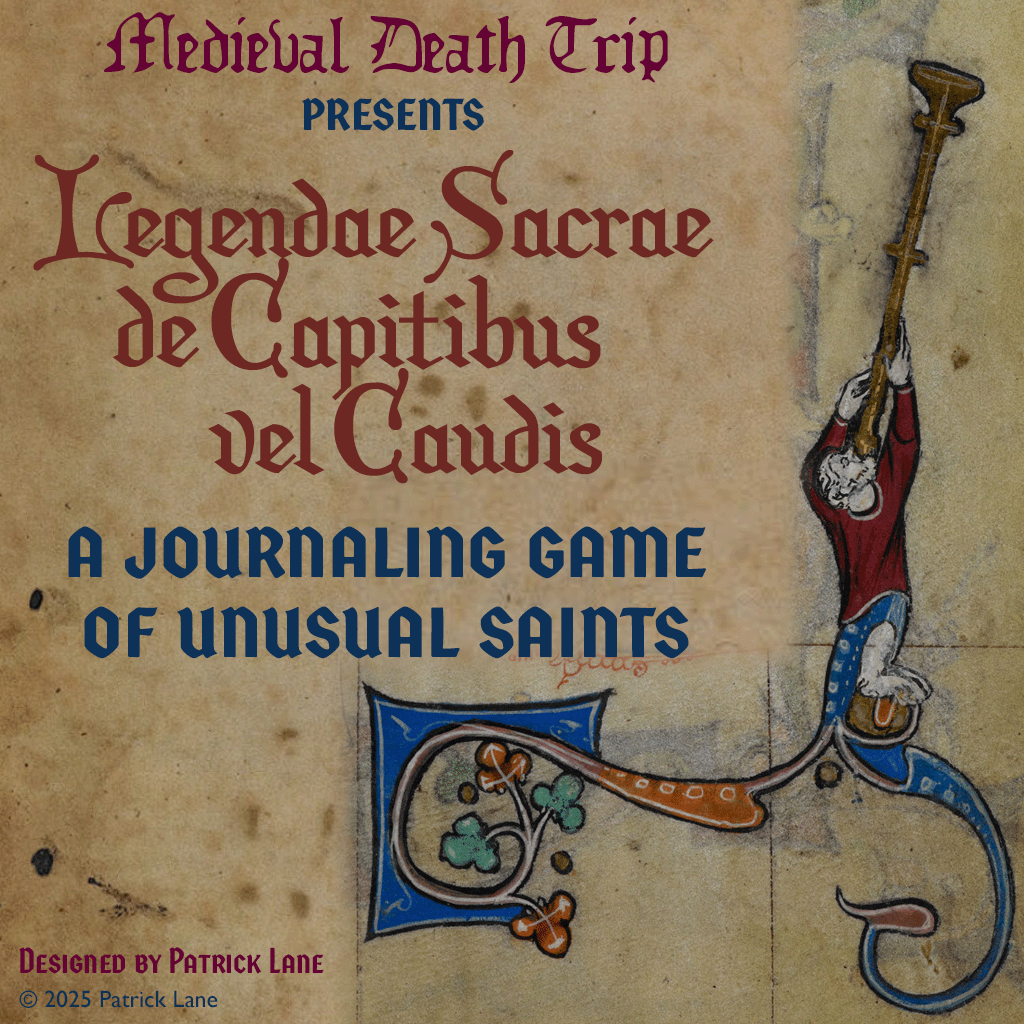
This year, Medieval Death Trip‘s annual Advent Calendar on Instagram is taking the form of a journaling game called Legendae Sacrae de Capitibus vel Caudis (Holy Legends of the Heads or the Tails), where you are invited to respond to daily prompts to construct your own mock medieval saint’s life.
What it is:
Legendae Sacrae de Capitibus vel Caudis (Holy Legends of the Heads or the Tails) is a non-competitive journaling game housed in an online Advent calendar, in which you respond to a series of prompts that will help you construct a written piece. In this game, that piece is a mock medieval saint’s life about a person born with an animal trait — namely, a body part.
What you’ll need:
- Writing tools (digital or physical)
- A means for randomly selecting between two options, “heads” or “tails” (e.g., a coin, odds or evens on a die, or your own intuition)
How to play:
- To play, check in on the Advent calendar posts that appear on Instagram @medievaldeathtrip. Each post has a “door” cover image hiding the prompts. You can also find all the posts by searching Instagram for #MDTAdvent25.
- Open the door (by advancing to the next image), and read the introduction to the day’s prompt. Then choose “heads” or “tails” using the method of your choice (flipping a coin, picking odds or evens by rolling a die or picking a word at random from a page and counting the number of letters, meditating on the question until a selection appears to you, etc.).
- Once you’ve determined if you will be “heads” or “tails” for that day’s prompt, advance to the first image after the introduction for “heads” or to the second image after the introduction for “tails.”
- Read the prompt and write a response with your choice of writing tool. Responses may range anywhere from a couple of sentences to a couple of paragraphs (or longer, if you’re feeling especially inspired).
- If you would like to share your work publicly, you can post your response as a comment on the day’s prompt on Instagram.
- You should begin the game with the set-up prompt for Dec. 1st and continue day-by-day in sequence until the conclusion on Dec. 25th.
Historical Context:
Hagiography, or writing about saints, was a major genre of medieval literature. Like popular genres today, it developed a common formula for organizing its narrative. The prompts of this journaling game will guide you through the conventional structure of a medieval saint’s life. This begins with establishing their origins, then narrates their birth and childhood, their education and spiritual guides, sketches out examples of their exceptional piety and notable events of their life (not necessarily in chronological order), and describes the circumstances of their death. The being alive part of a saint’s life is only half the story; their posthumous activities as a saint are typically given equal or greater attention. So next the life will discuss the disposition of their body or relics and their placement into a shrine or notable burial place, then present a catalogue of miracles attributed to the saint’s intercession with God.
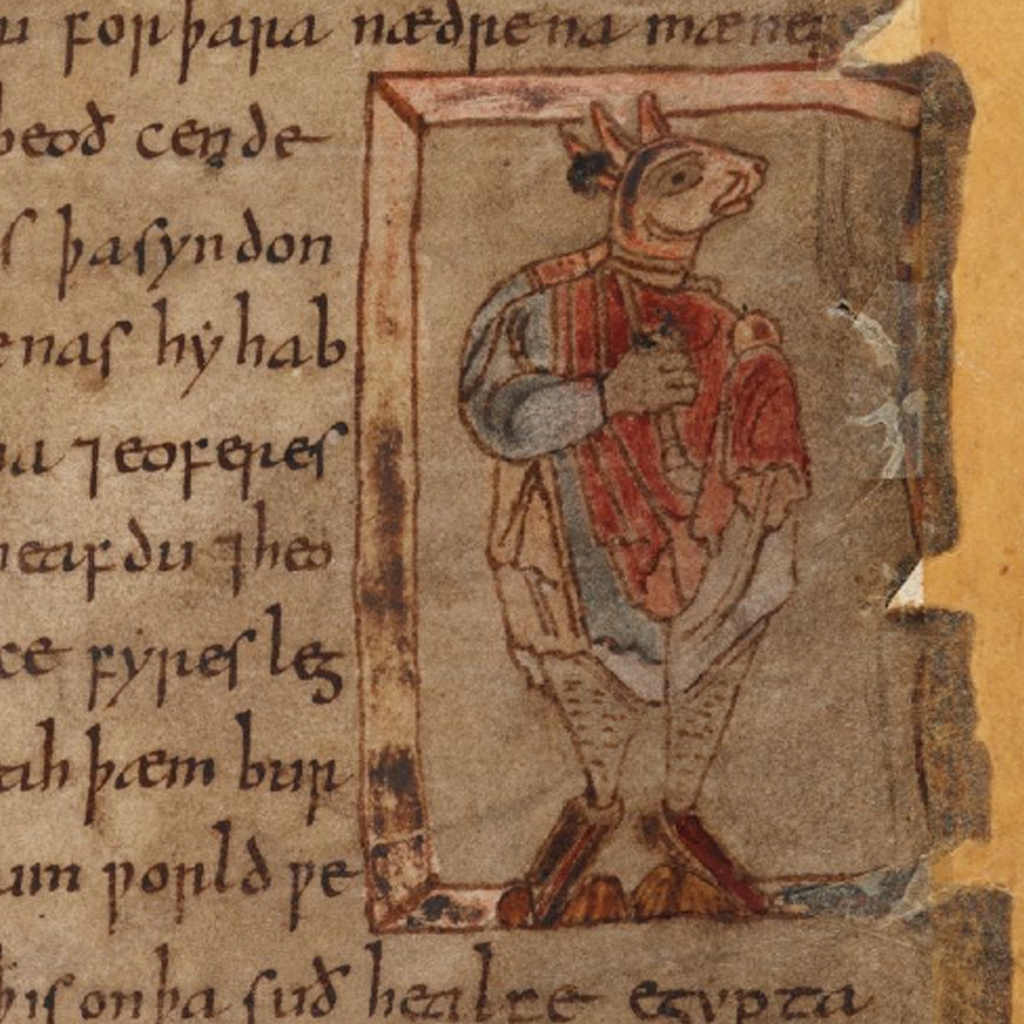
As for saints with animal parts, this is not a common convention. Medieval depictions of the legendary figure of St. Christopher sometimes depicted him as having a dog’s head — not, in this case, as a prodigy or unusual birth, but as a member of a race of dog-headed people reported to dwell in far away in the East by classical authorities. The Queen of Sheba (not a saint, but a biblical figure) was sometimes depicted in medieval art as having either a goat’s or a goose’s foot. I am not aware of any saint’s born with a bestial tail, but such hybrids frequently adorn the margins of illuminated manuscripts and seem a natural addition to the choir of unusual saints.
No AI Commitment:
I will not be using generative AI to produce images or content for this game. I can’t promise an absolute elimination of AI, as it is integrated into many Photoshop tools that I will be using in simple image clean-up and preparation. But I will not be using AI for full generation of images or content. All the “doors” of this year’s Advent Calendar are from photos I took myself.
–Patrick Lane




Hello my question is where to find all episodes? I want to love to give you guys a try.
You can find the show with most podcast player apps (though we’re not currently on Spotify or YouTube) — just search for “Medieval Death Trip.” You can also listen here on the website just through your browser. There’s an item in the sidebar labeled “Episodes” that you can click that will pull up all the episode posts that have an integrated media player to play the audio.